|
Century of Struggle and Sucess The Sikh Canadian Experience by Sandeep Singh Brar Part III Community Strength |
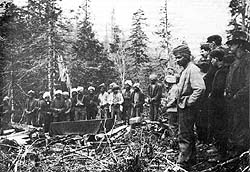 From the very beginning Sikhs soon realized that in this new and strange world with its hostile government they would have no one to rely upon for support other than themselves. The community remained very tight knit from its very beginning. When the first Sikh died in 1907 the community gathered to cremate the body as was their custom, except there were no crematoriums. The mayor of Vancouver refused to allow any cremation within the city limits. Christian missionaries were trying to force the idea of burial while at the same time not allowing any Sikh to be buried in any ‘White man’s’ grave yard. In the middle of the night Sikhs had to resort to taking the body to a distant forest to carry out their religious services and cremate the body in the morning. This made the community realize that they needed to have their own place of worship where they could carry on their religious ceremonies and customs, which are such an integral part of being a Sikh. From the very beginning Sikhs soon realized that in this new and strange world with its hostile government they would have no one to rely upon for support other than themselves. The community remained very tight knit from its very beginning. When the first Sikh died in 1907 the community gathered to cremate the body as was their custom, except there were no crematoriums. The mayor of Vancouver refused to allow any cremation within the city limits. Christian missionaries were trying to force the idea of burial while at the same time not allowing any Sikh to be buried in any ‘White man’s’ grave yard. In the middle of the night Sikhs had to resort to taking the body to a distant forest to carry out their religious services and cremate the body in the morning. This made the community realize that they needed to have their own place of worship where they could carry on their religious ceremonies and customs, which are such an integral part of being a Sikh.
"The Asiatics have come into British Columbia in such numbers that there are Hindu temples in Victoria and in Vancouver. The Hindus are a source of trouble. They are not suited to the country. They are immoral and quarrelsome and have not the stamina enough to become good workers. Some of them, however, make money. There are several real estate officers here conducted by Hindus, who are well enough off to keep automobiles. This very success constitutes a danger." (Mayor Beckwith of Victoria) "The Temple cost nearly $10,000, and is a monument to religious zeal and faith of a people far from home, in a strange land which has not treated them justly and among a people to whom they are united by but two bonds. The first of these is their attachment to the throne and empire of the British people who delivered India and the second is their unconquerable conviction that 'God hath made of one flesh all the nations of the earth.' It is the last rather than the first which makes the Sikh tolerant of the abuse and misrepresentation to which he has been subjected by the people who send missionaries to show him the way to salvation." (Walter W. Baer, Canadian Courier)
|
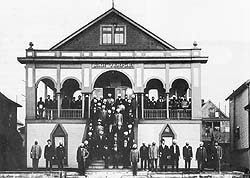 The first Gurdwara founded in North America was The Vancouver Sikh Temple on West 2nd Avenue opened on January 19th, 1908, in 1912 the Victoria Temple was built. Two more Gurdwaras were built that same year in Abbotsford and New Westminster. The Mayo Lumber Company founded by Mayo Singh built a Gurdwara on Vancouver Island in 1918.
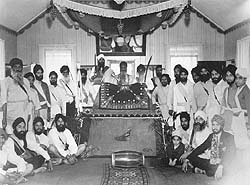 The newly founded Khalsa Diwan Society ran all of these Gurdwaras. The Society had independent committees in each Gurdwara, which coordinated events. For the major Sikh religious festivals during the year, the Society devised a method of rotating between which festival was held in which Gurdwara. The entire Sikh community would then make the journey to the specified Gurdwara for that festival. This resulted in the donations being spread evenly among all the Gurdwaras.